
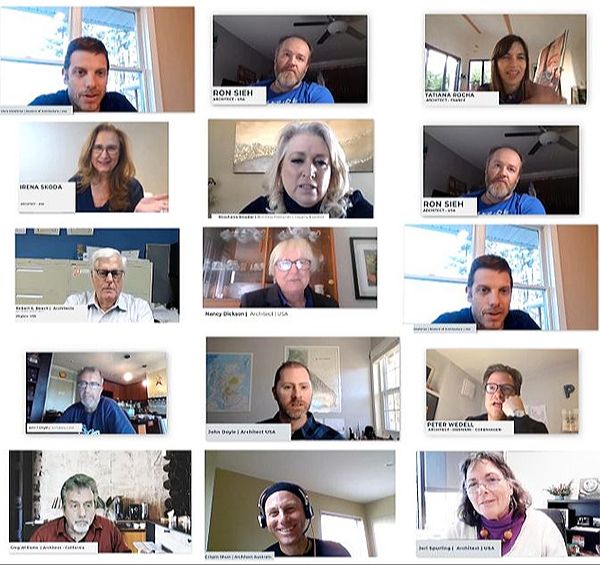
Find out what these building designers have taken away from, "The Artful Render Programme"

JONATHAN LEIBOWITZ
CEO, EMPOWERED SPACE
"We have been delighted utilizing Jason's services and highly recommend his abilities to create powerful concept design & presentation."

FRANC BRUGMAN
CEO BRUGMAN + PARTNERS
" Jason can take rough planning and create unbelievable, sometimes astounding presentations".

Eben Van Rensburg - Architect SA
What usually takes months to do, Jason can get done in a couple of days, and that is awesome, so yes, I can recommend this method, which can save you a lot of time."

Irena S. Architect USA
New York Architect.......I felt like this course was awesome;
it was In alignment with doing things expediently...

Crispin Shurr| Architect
Australia
Working through the process has enabled me to think about Design Architecture and what generates complexity, depth and form. I will take what I have learned back into my design process. This training has been a two-way street.

Eigh Pascual - Canadian Intern Architect
In my design studio, we do short proposals, and there is a consistent need to produce render proposals. The ArtfuL Sketch-like Renders look great at the conceptual stage and are easy to create.
Karibu Karanya - Uganda - Architect
My Background has been Archicad since 1990, will recommend it to any architect. The most crucial thing is the warm touch with the artful render compared to other programs, something priceless.

Ron Sieh | Architect USA
I like the sense of community sharing, and the tutorials are great. I was looking for a new technique. I traditionally use photo-realistic renders. I like the artistic, sketchy style and was excited to find a new way to produce easy renders that I don't have to overthink!

Binita Vora | Architect | Atlanta
I used photoshop to tweak the 3d imagery instead of returning to the 3d Model each time. The training was made simple and easy to understand.

Robert Beach Architects USA
"As impactful as the Artful Render is when you compare it to other Architects, our renders look far superior ..."

Jeri Spurling | Architect USA
I think it's genius how you put these various techniques from various software together and using your eye and knowledge....it helps take the control back from the computer in a pretty exciting way. I have never seen our business so busy, and this will help me.
The Pencil
Was Never
the Point.
Anyone can pick up AI and sketch an idea. Winning projects takes something else.
Entry-Level AI Is a Pencil. We Build the Hand That Holds It.
A pencil doesn't design anything. It waits for a hand, a decision, an intention. For decades, that's what "tools" meant in architecture — instruments that amplified skill but never replaced it.
AI breaks that rule. Handed to anyone, it doesn't just wait — it thinks, suggests, and generates on its own. That's the seduction, and it's also the trap. If the tool can think for you, average communication becomes free. Every firm can produce a decent rendering. Every competitor can prompt their way to a passable image.
Which means the image was never the advantage. It's the baseline now — the price of entry, not the differentiator.
Beyond the Image: The Real Competition Has Moved
Generating imagery is no longer the skill that wins a client. Everyone has that pencil now.
What separates a firm that impresses a client from one that blends in is the next layer — the deliberate combination of language models, techniques, and strategies assembled into something no single tool can produce alone.
This is hybrid practice: not one AI, one prompt, one output — but a stack. Multiple models chained with judgment. Techniques layered with intent. Strategy driving the tool, instead of the tool driving the outcome.
That hybrid fluency is the new craft. It's harder to copy, harder to automate, and it's exactly where projects are won or lost.
A Shrinking Industry Rewards Sharper Tools
The design workforce is contracting. Fewer seats, more competition for every commission.
In that environment, "good enough" communication isn't a strategy — it's a liability. Clients aren't comparing your renderings to what existed five years ago. They're comparing you to every other firm that also has access to AI.
The firms that pull ahead aren't the ones with access to AI — everyone has that. They're the ones who've built a system for using it better than the firm next door.
Your Toolkit Is Your Responsibility — And Your Advantage
No one is going to hand an architect the perfect AI workflow. It has to be built, tested, and rebuilt — deliberately assembled from what's actually working, not what's trending.
That means staying close to the field: knowing which models, plugins, and techniques are earning their place, and which are noise. It means treating your workflow as a living system, not a fixed setup.
Fragments Improve. The Process Never Stops Evolving.
A workflow built on AI isn't one tool doing everything — it's a chain of fragments, each handling a piece of the communication problem.
And each fragment has a shelf life. When a better technique, model, or process emerges, it doesn't get bolted on — it replaces the piece that came before it.
That's the discipline: not loyalty to a tool, but loyalty to the outcome. Continuous replacement of the weak link. A workflow that's always one version ahead of the version everyone else is still using.
The Pencil Draws.
The System Wins.
We don't sell you a tool. We build the hybrid system behind it — the strategy, the stack, and the workflow discipline that turns AI from a shared commodity into your unfair advantage.
See How We Build It